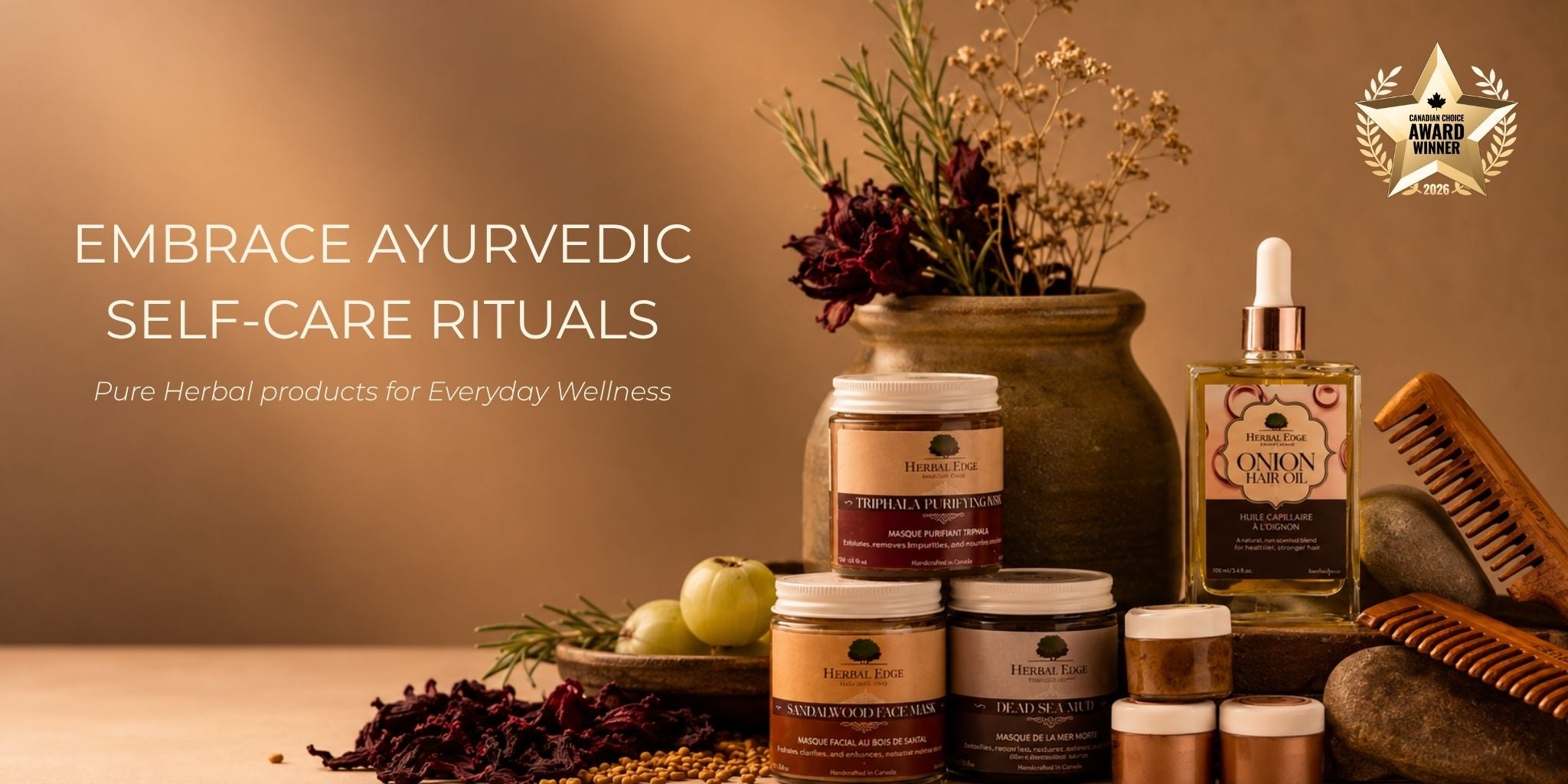


Walk into any beauty aisle and the face mask wall is overwhelming — charcoal, sheet masks, peel-offs, each promising a new face by morning. Ayurveda takes a simpler view: a face mask is powdered earth, clay, or fruit, mixed fresh with water, milk, or rose water, and applied for ten quiet minutes. No preservatives, no fragrance load, nothing you can't pronounce. (With one delicious exception: oil-based masks like our Triphala mask, which come ready to use straight from the jar.)
But "natural" doesn't mean "one size fits all." Different clays and botanicals do different things, and picking the wrong mask for your skin is how people conclude "face masks don't work for me." Here's an honest guide to matching an Ayurvedic mask to your skin — using the three masks we make at Herbal Edge as examples.
First: what makes a mask "Ayurvedic"?
In Ayurveda, skincare starts from the idea that skin reflects balance — and that the simplest preparations are often the best. Traditional Ayurvedic masks (lepas) are usually dry powders you activate yourself:
- Clays and earths (like Multani Mitti / Fuller's Earth) draw out excess oil and impurities
- Mineral muds (like Dead Sea mud) deliver minerals while they cleanse
- Fruit and herb powders (like sandalwood and orange peel) exfoliate gently and feed the skin antioxidants
Because you mix the powdered ones fresh, there's nothing sitting in a jar losing potency — and you control the texture by choosing your mixing liquid. That last part matters more than people think (more on that below). Oil-based masks like Triphala skip this step entirely: they're ready to apply as-is.
For oily or acne-prone skin: Dead Sea Mask or Multani Mitti clay
If your T-zone shines by noon and your pores clog easily, you want a mask that absorbs excess oil without stripping your skin raw.
Dead Sea mud is the heavyweight here. Sourced from the Dead Sea in Jordan, it's packed with minerals — magnesium, zinc, sodium, potassium, iron. It draws out impurities while the minerals do their work, and it's suitable for all skin types, so it's the safest first pick if you're unsure.
Multani Mitti (Fuller's Earth) is Ayurveda's classic answer to oily skin. It's a natural clay that absorbs excess sebum and gently exfoliates. Our Sandalwood & Orange Peel Clay Mask is built on it, with sandalwood and orange peel powder for tone and glow.
Mixing tip for oily skin: use plain water or rose water. Keep it simple — your skin already produces enough oil.

For dry or sensitive skin: Triphala — ready to use, no mixing
Dry skin and strong clays are a bad combination — a pure clay mask can leave dry skin feeling tight and uncomfortable. That doesn't mean skipping masks; it means choosing differently.
Triphala is the star for dry to normal skin. It's Ayurveda's famous three-fruit formula (amla, bibhitaki, haritaki), packed with antioxidants. Our Triphala Purifying Face Mask is an oil-based exfoliating mask — it pairs Triphala with coconut, jojoba, rosehip, and geranium oils, so it exfoliates and cleanses while actually nourishing. And because it's oil-based, it's ready to use straight from the jar: no mixing, no measuring, just apply.
If you prefer a powdered mask for dry skin, the trick is the mixing liquid: skip the water and mix with milk or rose water instead. The fats in milk add a layer of comfort that transforms the experience for dry skin.
For dull skin, uneven tone, or dark spots: Sandalwood & Orange Peel
If your complaint is dullness, uneven tone, or lingering dark spots, you want gentle exfoliation plus brightening botanicals.
Sandalwood has been cherished in Ayurveda for centuries for nurturing the skin, and orange peel brings natural vitamin C and gentle exfoliating action. Together with Multani Mitti's deep cleanse, our Sandalwood & Orange Peel Clay Mask targets pigmentation, acne marks, and that tired look — with rosehip and nutmeg in the blend for extra glow support.
Honest note: no mask erases pigmentation overnight. What a good weekly mask does is steadily improve texture and tone — think weeks, not days.
Can't decide? Start with the Discovery Set

If your skin is combination, or you simply want to try before committing, our Ayurvedic Face Mask Discovery Set ($15) gives you minis of all three masks — Sandalwood & Orange Peel, Triphala, and Dead Sea Mud. Use different masks on different zones (clay on the T-zone, Triphala on the cheeks), which is exactly what facialists do.
How to use your mask: the ritual
For powdered masks:
- Start with a clean face. Remove makeup and cleanse first — the mask should meet skin, not the day's residue.
- Mix fresh. 1–2 teaspoons of powder with just enough liquid to make a smooth paste. Water or rose water for oily skin; milk for dry skin.
- Apply evenly, avoiding the eye area. A brush works beautifully; clean fingers are fine too.
- Wait 10–15 minutes. Here's the mistake most people make: don't let a clay mask dry until it cracks. When it starts feeling tight, it's done — leaving it longer doesn't add benefits, it just dehydrates.
- Rinse with lukewarm water, using gentle circular motions for a light exfoliating effect as it comes off.
- Moisturize after. Always. A mask deep-cleans; your moisturizer restores.
For the oil-based Triphala mask, skip step 2 — apply it straight from the jar, leave for 10–15 minutes, then rinse.
Frequency: once a week is the sweet spot for most skin. Oily skin can go twice a week; sensitive skin should start with once every ten days.

A few honest caveats
- Patch test first. Natural doesn't mean hypoallergenic. Dab a little mask behind your ear and wait 24 hours before a full application.
- Tingling vs. burning. Mild tingling with clay masks is normal. Burning, itching, or redness is not — rinse off immediately.
- Masks support, they don't transform. A weekly mask improves texture, tone, and glow over time. It won't replace sunscreen, sleep, or a consistent routine — anyone telling you otherwise is selling something.
The bottom line
Oily / acne-prone → Dead Sea Mask or Sandalwood Clay Mask, mixed with water or rose water. Dry / sensitive → Triphala Purifying Face Mask, ready to use with no mixing needed. Dull / uneven tone → Sandalwood & Orange Peel Clay Mask, mixed with rose water. Combination or unsure → the Discovery Set, matching the liquid to each zone.
The Ayurvedic approach to masking was never about a miracle product — it's a small weekly ritual, matched to what your skin actually needs that day. Start there, and the glow tends to follow.
All four masks — Dead Sea, Sandalwood & Orange Peel, Triphala, and the Discovery Set — are in our Face Masks collection.